When it is time to replace a water heater, the tankless-versus-tank question comes up every time. Both work well in Arizona homes, but they suit different households, budgets, and priorities, and the local factors of hard water and desert climate change the calculation from what you might read in a national guide.
This comparison lays out the real tradeoffs for a Surprise or Buckeye homeowner so you can choose based on how your household actually uses hot water, not just on the sticker price.
How Each One Works
A tank water heater stores and continuously heats a reservoir of water, typically 40 to 50 gallons, so hot water is ready on demand until the tank runs out and needs to recover. A tankless unit heats water only as it flows, providing an effectively endless supply but at a limited flow rate at any one moment.
That core difference drives everything else. A tank gives you a large burst of hot water and then a recovery pause; a tankless gives you a steady, unlimited stream that can be stretched thin if too many fixtures run at once.
Upfront Cost and Installation
Tank heaters win on upfront cost. A tank replacement in the Phoenix area commonly runs about $800 to $2,000 installed, while a tankless installation typically runs $1,500 to $3,500. The tankless premium comes largely from installation, since it often needs upgraded gas lines, new venting, or additional electrical capacity.
If you are simply replacing a failed tank with a similar unit, the tank route is faster and cheaper. If you are remodeling, adding capacity, or want the long-term benefits, the higher tankless investment can pay off over the life of the unit.
- Tank replacement: about $800 to $2,000 installed
- Tankless installation: about $1,500 to $3,500 installed
- Tankless often needs gas, venting, or electrical upgrades
Lifespan, Space, and Energy
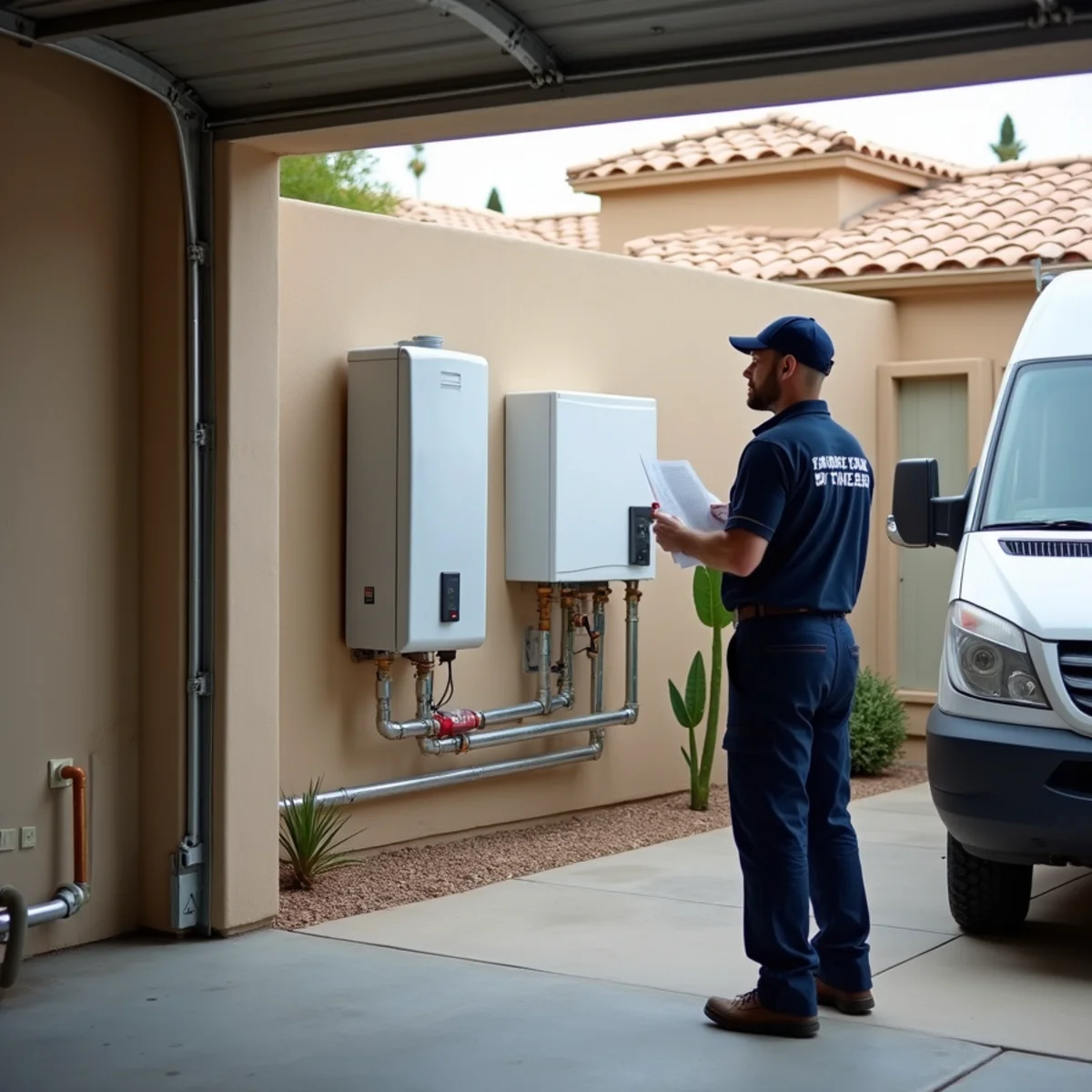
Tankless units generally last longer than tank units and use less energy, since they do not reheat stored water around the clock. They also free up floor space, mounting on a wall, which appeals in homes where the water heater sits in a garage or closet you would rather use.
Tank heaters have a shorter expected life and standby energy loss, but they are simpler and cheaper to repair when a part fails. For many households, the choice comes down to how long you plan to stay in the home and whether the energy and lifespan savings justify the higher upfront cost.
The Hard-Water Factor
This is where Arizona changes the math. Local water at 15 to 20 grains per gallon scales both types, but tankless units are especially sensitive because scale forms quickly on their heat exchanger and can reduce performance or trigger error codes. Manufacturers typically require periodic descaling, and many recommend a water softener to keep the warranty valid.
This does not rule out tankless; it means a softener is close to essential if you go that route. A tank heater also benefits from softening and annual flushing, but a tankless without treatment in hard-water country will need more maintenance and may fail early.
Which Is Right for Your Home?
A large or growing household that regularly runs out of hot water, or one that wants endless hot water and long-term energy savings and is willing to add a softener, is a strong candidate for tankless. A household that wants the lowest upfront cost, a simple like-for-like replacement, or backup for a very high simultaneous demand is often better served by a right-sized tank.
The best answer depends on your specific usage, your existing gas and electrical setup, and whether you treat your water. Madrid Plumbing provides water heater repair and replacement across Surprise and the West Valley and can size either option correctly, with the tradeoffs laid out in writing.
Maintenance and Long-Term Care
Whichever type you choose, maintenance is what determines whether it reaches its potential lifespan in Arizona. A tank heater should be flushed annually to clear the sediment that hard water leaves behind, which protects capacity and efficiency. Skipping that step in the West Valley is the fastest way to lose years off a tank.
Tankless units demand more discipline. Because scale forms on the heat exchanger, most manufacturers require periodic descaling, often yearly, and many make that maintenance and a water softener conditions of the warranty. Factor that ongoing care into your decision: a tankless unit rewards an owner who keeps up with it and a softened water supply, while a tank is more forgiving of the occasional missed flush. Matching the choice to how much maintenance you will realistically do is as important as the upfront comparison. Be honest with yourself about the upkeep you will actually keep up with, because the best water heater is the one that fits both your household demand and your habits, not simply the one with the most impressive specifications on paper.
How Madrid Plumbing Can Help
Frequently Asked Questions
It can be, especially for larger households wanting endless hot water and long-term energy savings. The key caveat is hard water: a tankless unit needs a water softener and periodic descaling to perform well and keep its warranty valid in the West Valley.
Tankless units generally last longer than tank units, but only with proper maintenance. In hard-water areas, untreated water causes scale that can shorten a tankless heater lifespan significantly, so a softener and descaling are important.
As a Phoenix-area benchmark, tankless installation runs about $1,500 to $3,500 versus about $800 to $2,000 for a tank replacement. The difference is mostly installation, since tankless often needs gas line, venting, or electrical upgrades.